← Browse All Recipes
🥗

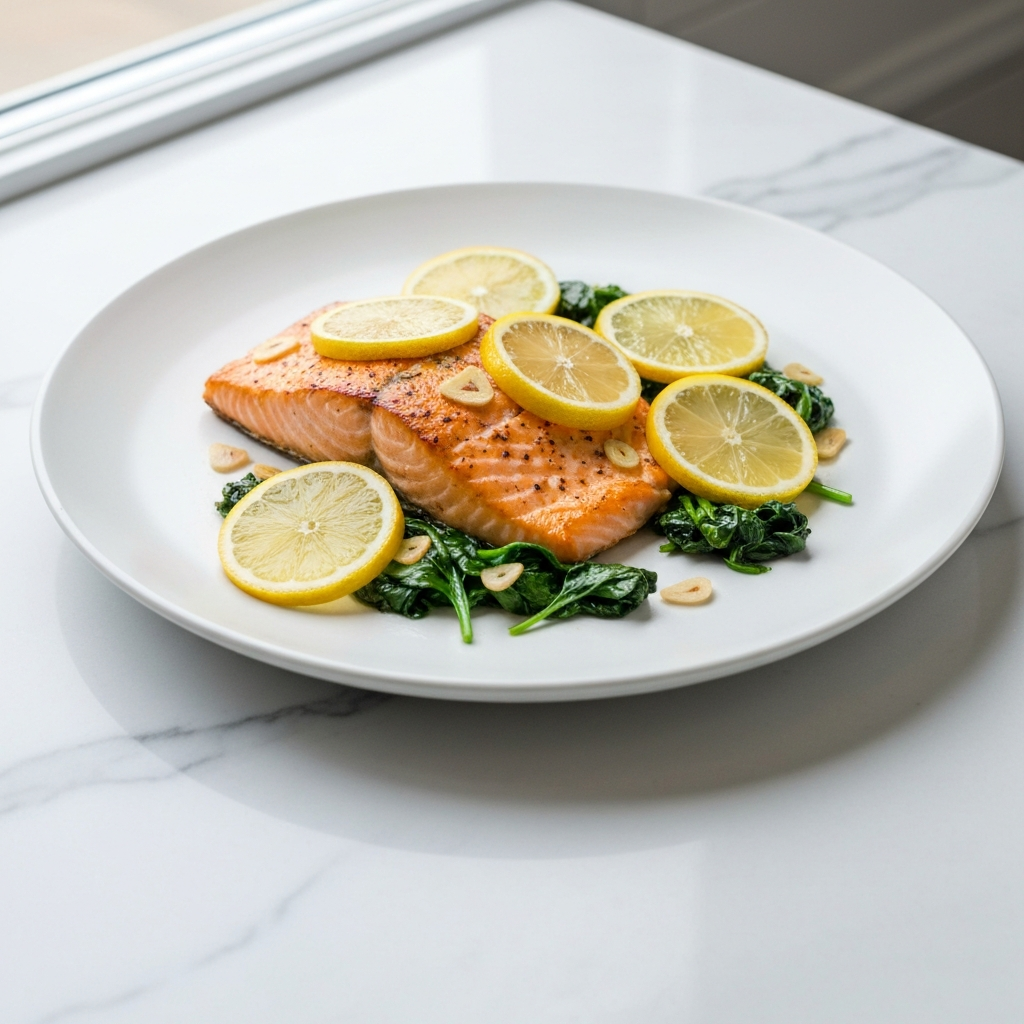
Baked Salmon with Lemon & Garlic Spinach
Lunch American Easy Normal ⏱ 25 min · 👤 1 serving
🐟 Rich in Omega-3 🦴 High Calcium 💪 High Protein 🫐 Antioxidant Rich
Baked Salmon with Lemon & Garlic Spinach

📊 Nutrition Facts (whole dish)

647
Calories
33.5g
Protein
26.6g
Fat
68.1g
Carbs
6.0g
Fiber
147mg
Sodium
315mg
Calcium
6mg
Iron
934mg
Potassium
124mg
Magnesium
2.3g
Omega-3

🛒 Ingredients

Firm Tofucooked20g

👩‍🍳 Cooking Instructions

1
Cook brown rice according to package directions, using a 1 part rice to 2 parts water ratio, bringing to a boil for 15 minutes until fully absorbed.
2
Preheat oven to 375°F (190°C). Pat the salmon fillet dry and season generously with salt, pepper, rosemary, and thyme. Bake the salmon fillet on a lined baking sheet for 14-16 minutes, or until it reaches an internal temperature of 145°F.
3
While the salmon bakes, heat 2 tablespoons of olive oil in a large skillet over medium heat. Add minced garlic and sauté for 30 seconds until fragrant. Add spinach and cook, stirring constantly, for 2-3 minutes until wilted; remove from heat and set aside.
4
In a separate saucepan, heat 1 tablespoon of olive oil over medium heat. Gently sauté the firm tofu cubes for 5-7 minutes, turning occasionally, until golden brown on all sides. Pour in the lowfat milk, bring to a gentle simmer, and cook for an additional 4 minutes, allowing the mixture to thicken slightly.
5
To serve, plate the cooked brown rice, top with the baked salmon fillet, arrange the sautéed spinach and garlic mixture alongside it, and drizzle the tofu-milk mixture over the side.

🏥 Health & Wellness Notes (evidence-based)

🧠 Brain-Health (MIND Diet) — Antioxidant-Rich, Omega-3, B-Vitamins

Based on the MIND diet (Mediterranean-DASH Intervention for Neurodegenerative Delay) published in Alzheimer's & Dementia (Morris et al., 2015): green leafy vegetables, berries, nuts, whole grains, fish, poultry, and olive oil as primary fat. These foods are rich in vitamin E, folate, omega-3s, and polyphenols that protect against cognitive decline.

Key nutrients per serving: Green leafy vegetables present, berries or polyphenol-rich fruit, omega-3 EPA+DHA ≥500mg, vitamin E ≥5mg
⚠️ Verification Notes:
  • No berries (MIND recommends ≥2 servings/week)
📚 References (2)
MIND Diet Slows Cognitive Decline with Aging (Morris et al., 2015) DOI: 10.1016/j.jalz.2014.11.009
"The MIND diet score was significantly associated with slower cognitive decline. Brain-healthy food groups: green leafy v..."
Trial of the MIND Diet for Prevention of Cognitive Decline (NEJM 2023) DOI: 10.1056/NEJMoa2302368
"High consumption of green leafy vegetables, berries, nuts, and olive oil are linked to cognitive protection. The MIND di..."
🦿 Joint Health — Anti-Inflammatory, Omega-3 Rich, Antioxidant

Based on OARSI Guidelines: Mediterranean diet pattern with emphasis on anti-inflammatory foods. Omega-3 fatty acids, vitamin D, avoidance of pro-inflammatory foods. Weight management crucial.

Key nutrients per serving: Omega-3 >1g, vitamin D, antioxidants, fiber >5g, whole grains, olive oil
📚 References (1)
[Nutritional guidelines for the improvement of patients with osteoarthritis]. (Nutricion hospitalaria, 2025) DOI: 10.20960/nh.06096
"Introduction: osteoarthritis is a chronic disease characterized by the progressive degradation of articular cartilage, s..."
🧠 Alzheimer's Support — MIND Diet, Antioxidant-Rich, Omega-3, B-Vitamins

Based on the MIND diet study (Morris et al., 2015): green leafy vegetables, berries, nuts, whole grains, fish, poultry, olive oil. Rich in folate, vitamin E, omega-3s, and polyphenols.

Key nutrients per serving: Green leafy vegetables, berries present, omega-3 >500mg, vitamin E >5mg
📚 References (1)
Effects of the MIND Diet on the Cognitive Function of Older Adults: A Systematic Review. (Clinical nutrition research, 2025) DOI: 10.7762/cnr.2025.14.4.318
"The Mediterranean-DASH Intervention for Neurodegenerative Delay (MIND) diet is a brain-focused dietary pattern designed ..."
🦯 Frailty Support — Energy-Dense, High Protein, Easy to Eat

Based on ICFSR Clinical Guidelines: energy 30kcal/kg, protein 1.2-1.5g/kg. Emphasize energy-dense foods, fortified meals. Soft textures, small frequent meals.

Key nutrients per serving: Energy >400kcal per meal, protein >20g, easy to chew/swallow, nutrient-dense
📚 References (3)
Individualised nutritional support in medical inpatients at nutritional risk: a randomised clinical trial. (Lancet (London, England), 2019) DOI: 10.1016/S0140-6736(18)32776-4
"Guidelines recommend the use of nutritional support during hospital stays for medical patients (patients not critically ..."
Associations of fats and carbohydrate intake with cardiovascular disease and mortality in 18 countries from five continents (PURE): a prospective cohort study. (Lancet (London, England), 2017) DOI: 10.1016/S0140-6736(17)32252-3
"The relationship between macronutrients and cardiovascular disease and mortality is controversial. Most available data a..."
Nutrition and protein energy homeostasis in elderly. (Mechanisms of ageing and development, 2014) DOI: 10.1016/j.mad.2014.01.008
"Protein-energy homeostasis is a major determinant of healthy aging. Inadequate nutritional intakes and physical activity..."
💔 Heart Failure — Low Sodium, Fluid-Conscious, Potassium-Balanced

Based on AHA/ACC 2022 Heart Failure Guidelines: sodium <1500-2000mg/day. Sodium and fluid recommendations should be individualized; fluid restriction may be prescribed for selected patients with congestion, hyponatremia or advanced heart failure — do not restrict fluids unless advised by the treating clinician. Emphasis on DASH-aligned eating pattern with potassium-rich foods unless contraindicated.

Key nutrients per serving: Sodium <400mg per meal, saturated fat <5g, fluid-dense foods balanced
📚 References (1)
Lifestyle Modification in Heart Failure Management: Are We Using Evidence-Based Recommendations in Real World Practice? (International journal of heart failure, 2023) DOI: 10.36628/ijhf.2022.0032
"The heart failure (HF) guideline's purpose is to assist medical professionals while treating patients with HF in accorda..."
🍵 Gentle Digestion — Small Portions, Low Acid, Soft Texture, Easy to Digest

Based on AGA Clinical Practice Guidelines: smaller, more frequent meals (5-6/day), limit high-fat and spicy foods. Emphasize cooked over raw vegetables, lean proteins, moderate fiber.

Key nutrients per serving: Fat <20g per meal, fiber 3-5g, soft texture, small portion size, non-acidic
📚 References (1)
Prevalence of functional gastrointestinal disorders in Taiwan: questionnaire-based survey for adults based on the Rome III criteria. (Asia Pacific journal of clinical nutrition, 2012)
"Functional gastrointestinal disorders (FGID) are a group of disorders of the digestive system in which the chronic or re..."
🫁 COPD Support — High Healthy Fat, Adequate Protein, Easy to Digest

Based on ERS/ATS Nutrition Guidelines: higher fat (35-45% calories) to reduce CO2 production. Protein 1.2-1.5g/kg to preserve respiratory muscle. Small, frequent, nutrient-dense meals.

Key nutrients per serving: Protein >20g, healthy fats 15-20g, fiber 3-5g, easy to chew and swallow
💪 Sarcopenia Prevention — High Protein, Leucine-Rich, Vitamin D

Based on ESPEN 2024 Sarcopenia Guidelines: protein 1.2-1.5g/kg/day with 25-30g per meal. Vitamin D 800-1000 IU/day. Resistance exercise paired with protein intake.

Key nutrients per serving: Protein >25g per meal, vitamin D sources, calcium >200mg, energy >400kcal
📚 References (3)
Protein intake and exercise for optimal muscle function with aging: recommendations from the ESPEN Expert Group. (Clinical nutrition (Edinburgh, Scotland), 2014) DOI: 10.1016/j.clnu.2014.04.007
"The aging process is associated with gradual and progressive loss of muscle mass along with lowered strength and physica..."
Nutritional intake and diet quality over three years following liver transplantation. (Clinical nutrition ESPEN, 2025) DOI: 10.1016/j.clnesp.2025.06.026
"Recipients of liver transplantation (LT) are at high risk of malnutrition, sarcopenia and cardiovascular disease, yet no..."
Muscle Strength and Phase Angle Are Potential Markers for the Efficacy of Multidisciplinary Weight-Loss Program in Patients with Sarcopenic Obesity. (Journal of clinical medicine, 2024) DOI: 10.3390/jcm13175237
"..."
🩹 Wound Healing — Very High Protein, Zinc, Vitamin C, Vitamin A

Based on NPUAP/EPUAP 2019 Guidelines: protein 1.25-1.5g/kg/day, energy 30-35 kcal/kg/day. Vitamin C 500mg, zinc 15-30mg, vitamin A for collagen synthesis.

Key nutrients per serving: Protein >25g per meal, vitamin C-rich foods, zinc >5mg, vitamin A sources
📚 References (1)
Nutritional treatment of pressure ulcers: what is the evidence? (Journal of the American Association of Nurse Practitioners, 2013) DOI: 10.1002/2327-6924.12025
"To review the literature on the nutritional treatment of pressure ulcers, with an emphasis on long-term care issues. The..."
🌾 Constipation Relief — High Fiber, Adequate Fluids, Probiotic-Rich

Based on ACG Clinical Guidelines: fiber 25-30g/day from diverse sources, fluids >1.7L/day. Prunes, kiwi, psyllium, and fermented foods shown effective.

Key nutrients per serving: Fiber >5g per meal, fluids, probiotics, magnesium >50mg, whole grains present
📚 References (3)
AGA Clinical Practice Update on Pregnancy-Related Gastrointestinal and Liver Disease: Expert Review. (Gastroenterology, 2024) DOI: 10.1053/j.gastro.2024.06.014
"The purpose of this American Gastroenterological Association (AGA) Institute Clinical Practice Update is to review the a..."
Impact of resistant starch type 3 on fecal microbiota and stool frequency in Thai adults with chronic constipation randomized clinical trial. (Scientific reports, 2024) DOI: 10.1038/s41598-024-79465-1
"Constipation poses a significant health concern affecting individuals of varying ages and geographic locations worldwide..."
Short-Term Daily Intake of Polydextrose Fiber Does Not Shorten Intestinal Transit Time in Constipated Adults: A Randomized Controlled Trial. (Nutrients, 2018) DOI: 10.3390/nu10070920
"Chronic constipation (CC) remains a common gastrointestinal (GI) disorder that conveys a substantial healthcare burden. ..."
⚠️ This information is for reference only. Always consult your healthcare provider or registered dietitian before making dietary changes. Not medical advice.
🖨️ Print / Save Recipe
NutriHearth Family Nutrition Assistant · Evidence-based recipe · Generated for demo purposes · Not medical advice