← Browse All Recipes
🍎

Edamame & Almond Trail Mix
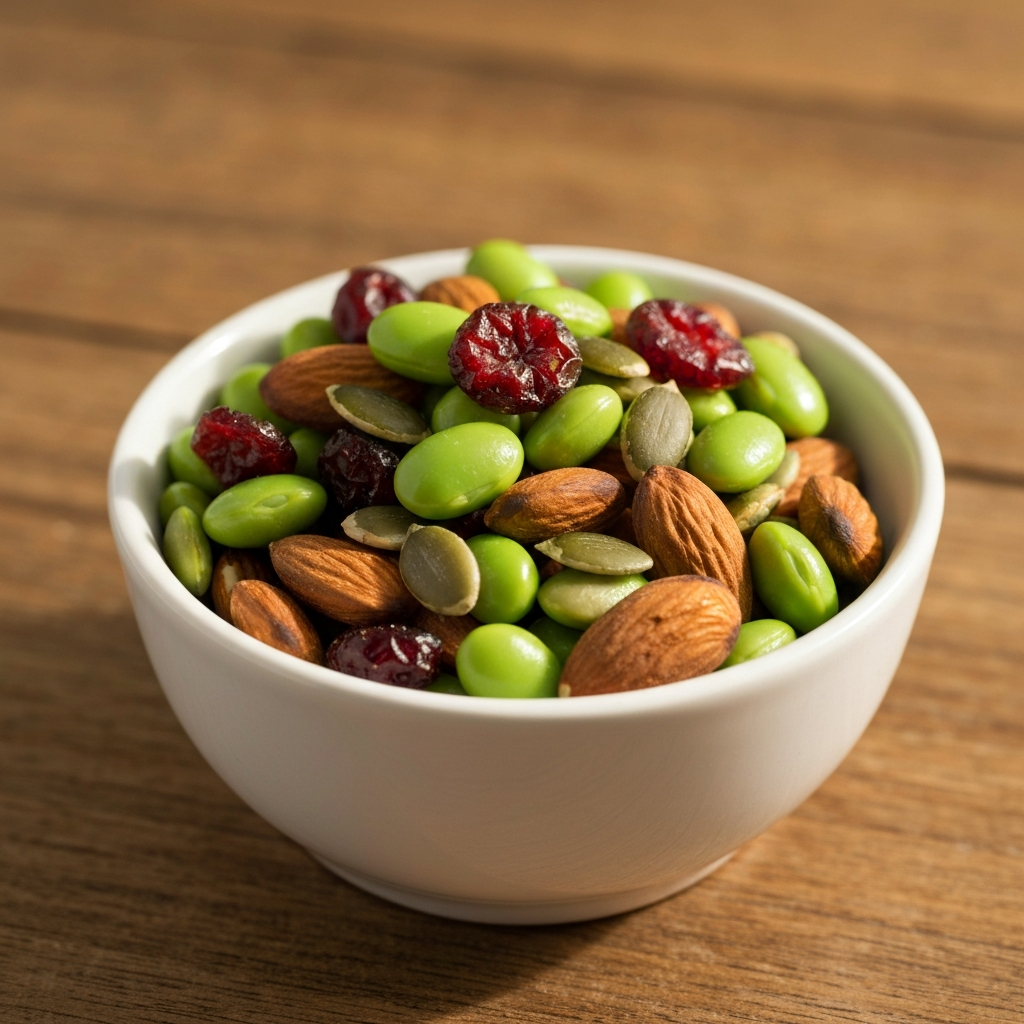
Snack American Easy Normal ⏱ 5 min · 👤 1 serving
💪 High Protein 🐟 Rich in Omega-3 🌱 Vegan
Edamame & Almond Trail Mix

📊 Nutrition Facts (whole dish)

213
Calories
10.7g
Protein
16.6g
Fat
9.1g
Carbs
5.1g
Fiber
3mg
Sodium
82mg
Calcium
2mg
Iron
394mg
Potassium
88mg
Magnesium
0.9g
Omega-3

🛒 Ingredients

👩‍🍳 Cooking Instructions

1
Preheat oven to 350°F (175°C). On a large baking sheet, combine the edamame, almonds, and walnuts.
2
Spread the mixture in a single layer. Bake for 12-15 minutes, stirring once halfway through, until all ingredients are lightly golden and fragrant.
3
Remove the baking sheet from the oven. Immediately toss the warm mix with a pinch of salt and black pepper to season evenly.
4
Allow the Edamame & Almond Trail Mix to cool completely on the baking sheet before serving or storing.

🏥 Health & Wellness Notes (evidence-based)

🩸 Diabetes-Friendly — Low Glycemic Index, Controlled Carbohydrates

Based on the ADA Standards of Care in Diabetes—2026, this meal emphasizes low-glycemic index carbohydrates (whole grains, legumes, non-starchy vegetables) and lean protein sources, which help maintain stable postprandial glucose levels.

Key nutrients per serving: Low GI foods (<55), fiber ≥3g per serving, saturated fat <10% of calories
📚 References (2)
Standards of Care in Diabetes—2026 (ADA Diabetes Care) DOI: 10.2337/dc26-SREV
"Carbohydrate intake should emphasize low-glycemic index foods, non-starchy vegetables, whole fruits, legumes, and whole ..."
ADA Diabetes & Nutrition Recommendations
"Choose more non-starchy vegetables, lean meats or plant-based proteins, quality carbohydrates (whole grains, fruits, veg..."
🫀 Heart-Healthy — Low Saturated Fat, High Soluble Fiber, Omega-3 Rich

Based on 2026 lipid guideline (Clin Res Cardiol) and current lipid management guidelines: saturated fat <7% of total calories, increased viscous fiber (10-25g/day), and omega-3 fatty acids from fish or plant sources. Plant sterols from legumes, nuts, and whole grains provide additional LDL reduction.

Key nutrients per serving: Saturated fat <7g per serving, fiber ≥5g, omega-3 ≥0.5g, zero trans fat
📚 References (2)
Dietary Therapy for LDL Cholesterol Reduction (NCBI Bookshelf)
"Reduce saturated fat to <7% of total calories; eliminate trans fat. Increase soluble fiber (10-25g/day), plant sterols/s..."
2026 Lipid Guideline (Clin Res Cardiol)
"Therapeutic lifestyle changes (TLC) as first-line: saturated fat <7% calories, dietary cholesterol <200mg/day, increased..."
🧠 Brain-Health (MIND Diet) — Antioxidant-Rich, Omega-3, B-Vitamins

Based on the MIND diet (Mediterranean-DASH Intervention for Neurodegenerative Delay) published in Alzheimer's & Dementia (Morris et al., 2015): green leafy vegetables, berries, nuts, whole grains, fish, poultry, and olive oil as primary fat. These foods are rich in vitamin E, folate, omega-3s, and polyphenols that protect against cognitive decline.

Key nutrients per serving: Green leafy vegetables present, berries or polyphenol-rich fruit, omega-3 EPA+DHA ≥500mg, vitamin E ≥5mg
⚠️ Verification Notes:
  • No green leafy vegetables (MIND recommends ≥6 servings/week)
  • No berries (MIND recommends ≥2 servings/week)
📚 References (2)
MIND Diet Slows Cognitive Decline with Aging (Morris et al., 2015) DOI: 10.1016/j.jalz.2014.11.009
"The MIND diet score was significantly associated with slower cognitive decline. Brain-healthy food groups: green leafy v..."
Trial of the MIND Diet for Prevention of Cognitive Decline (NEJM 2023) DOI: 10.1056/NEJMoa2302368
"High consumption of green leafy vegetables, berries, nuts, and olive oil are linked to cognitive protection. The MIND di..."
🦿 Joint Health — Anti-Inflammatory, Omega-3 Rich, Antioxidant

Based on OARSI Guidelines: Mediterranean diet pattern with emphasis on anti-inflammatory foods. Omega-3 fatty acids, vitamin D, avoidance of pro-inflammatory foods. Weight management crucial.

Key nutrients per serving: Omega-3 >1g, vitamin D, antioxidants, fiber >5g, whole grains, olive oil
📚 References (1)
[Nutritional guidelines for the improvement of patients with osteoarthritis]. (Nutricion hospitalaria, 2025) DOI: 10.20960/nh.06096
"Introduction: osteoarthritis is a chronic disease characterized by the progressive degradation of articular cartilage, s..."
🧠 Alzheimer's Support — MIND Diet, Antioxidant-Rich, Omega-3, B-Vitamins

Based on the MIND diet study (Morris et al., 2015): green leafy vegetables, berries, nuts, whole grains, fish, poultry, olive oil. Rich in folate, vitamin E, omega-3s, and polyphenols.

Key nutrients per serving: Green leafy vegetables, berries present, omega-3 >500mg, vitamin E >5mg
📚 References (1)
Effects of the MIND Diet on the Cognitive Function of Older Adults: A Systematic Review. (Clinical nutrition research, 2025) DOI: 10.7762/cnr.2025.14.4.318
"The Mediterranean-DASH Intervention for Neurodegenerative Delay (MIND) diet is a brain-focused dietary pattern designed ..."
💔 Heart Failure — Low Sodium, Fluid-Conscious, Potassium-Balanced

Based on AHA/ACC 2022 Heart Failure Guidelines: sodium <1500-2000mg/day. Sodium and fluid recommendations should be individualized; fluid restriction may be prescribed for selected patients with congestion, hyponatremia or advanced heart failure — do not restrict fluids unless advised by the treating clinician. Emphasis on DASH-aligned eating pattern with potassium-rich foods unless contraindicated.

Key nutrients per serving: Sodium <400mg per meal, saturated fat <5g, fluid-dense foods balanced
📚 References (1)
Lifestyle Modification in Heart Failure Management: Are We Using Evidence-Based Recommendations in Real World Practice? (International journal of heart failure, 2023) DOI: 10.36628/ijhf.2022.0032
"The heart failure (HF) guideline's purpose is to assist medical professionals while treating patients with HF in accorda..."
🫁 COPD Support — High Healthy Fat, Adequate Protein, Easy to Digest

Based on ERS/ATS Nutrition Guidelines: higher fat (35-45% calories) to reduce CO2 production. Protein 1.2-1.5g/kg to preserve respiratory muscle. Small, frequent, nutrient-dense meals.

Key nutrients per serving: Protein >20g, healthy fats 15-20g, fiber 3-5g, easy to chew and swallow
💪 Sarcopenia Prevention — High Protein, Leucine-Rich, Vitamin D

Based on ESPEN 2024 Sarcopenia Guidelines: protein 1.2-1.5g/kg/day with 25-30g per meal. Vitamin D 800-1000 IU/day. Resistance exercise paired with protein intake.

Key nutrients per serving: Protein >25g per meal, vitamin D sources, calcium >200mg, energy >400kcal
⚠️ Verification Notes:
  • Protein 10.7g (ESPEN sarcopenia target >20g/meal)
📚 References (3)
Protein intake and exercise for optimal muscle function with aging: recommendations from the ESPEN Expert Group. (Clinical nutrition (Edinburgh, Scotland), 2014) DOI: 10.1016/j.clnu.2014.04.007
"The aging process is associated with gradual and progressive loss of muscle mass along with lowered strength and physica..."
Nutritional intake and diet quality over three years following liver transplantation. (Clinical nutrition ESPEN, 2025) DOI: 10.1016/j.clnesp.2025.06.026
"Recipients of liver transplantation (LT) are at high risk of malnutrition, sarcopenia and cardiovascular disease, yet no..."
Muscle Strength and Phase Angle Are Potential Markers for the Efficacy of Multidisciplinary Weight-Loss Program in Patients with Sarcopenic Obesity. (Journal of clinical medicine, 2024) DOI: 10.3390/jcm13175237
"..."
🩹 Wound Healing — Very High Protein, Zinc, Vitamin C, Vitamin A

Based on NPUAP/EPUAP 2019 Guidelines: protein 1.25-1.5g/kg/day, energy 30-35 kcal/kg/day. Vitamin C 500mg, zinc 15-30mg, vitamin A for collagen synthesis.

Key nutrients per serving: Protein >25g per meal, vitamin C-rich foods, zinc >5mg, vitamin A sources
📚 References (1)
Nutritional treatment of pressure ulcers: what is the evidence? (Journal of the American Association of Nurse Practitioners, 2013) DOI: 10.1002/2327-6924.12025
"To review the literature on the nutritional treatment of pressure ulcers, with an emphasis on long-term care issues. The..."
🌾 Constipation Relief — High Fiber, Adequate Fluids, Probiotic-Rich

Based on ACG Clinical Guidelines: fiber 25-30g/day from diverse sources, fluids >1.7L/day. Prunes, kiwi, psyllium, and fermented foods shown effective.

Key nutrients per serving: Fiber >5g per meal, fluids, probiotics, magnesium >50mg, whole grains present
📚 References (3)
AGA Clinical Practice Update on Pregnancy-Related Gastrointestinal and Liver Disease: Expert Review. (Gastroenterology, 2024) DOI: 10.1053/j.gastro.2024.06.014
"The purpose of this American Gastroenterological Association (AGA) Institute Clinical Practice Update is to review the a..."
Impact of resistant starch type 3 on fecal microbiota and stool frequency in Thai adults with chronic constipation randomized clinical trial. (Scientific reports, 2024) DOI: 10.1038/s41598-024-79465-1
"Constipation poses a significant health concern affecting individuals of varying ages and geographic locations worldwide..."
Short-Term Daily Intake of Polydextrose Fiber Does Not Shorten Intestinal Transit Time in Constipated Adults: A Randomized Controlled Trial. (Nutrients, 2018) DOI: 10.3390/nu10070920
"Chronic constipation (CC) remains a common gastrointestinal (GI) disorder that conveys a substantial healthcare burden. ..."
⚠️ This information is for reference only. Always consult your healthcare provider or registered dietitian before making dietary changes. Not medical advice.
🖨️ Print / Save Recipe
NutriHearth Family Nutrition Assistant · Evidence-based recipe · Generated for demo purposes · Not medical advice